After the Last Glass: How Directors Turn the Morning After Into Cinema's Most Honest Reckoning
Wine, at its most seductive, is a covenant. It promises warmth, revelation, the loosening of what has been too tightly held. Cinema has long understood this covenant—and, more pointedly, has understood what happens when it expires. The hangover film, as a distinct aesthetic mode, is not simply a study in excess. It is cinema's most rigorous examination of the distance between desire and consequence, between the golden hour of the first pour and the gray, unforgiving morning that follows.
Sophisticated filmmakers have recognized that the physical phenomenology of a hangover—the hypersensitivity to light and sound, the fractured sense of time, the body's rebellion against the mind's ambitions—offers a uniquely honest visual and sonic language. These are not merely symptoms to be played for comedy or pathos. They are, in the hands of the most accomplished directors, a formal grammar through which cinema can speak truths that the intoxicated hours actively suppress.
The Aesthetics of the Aftermath
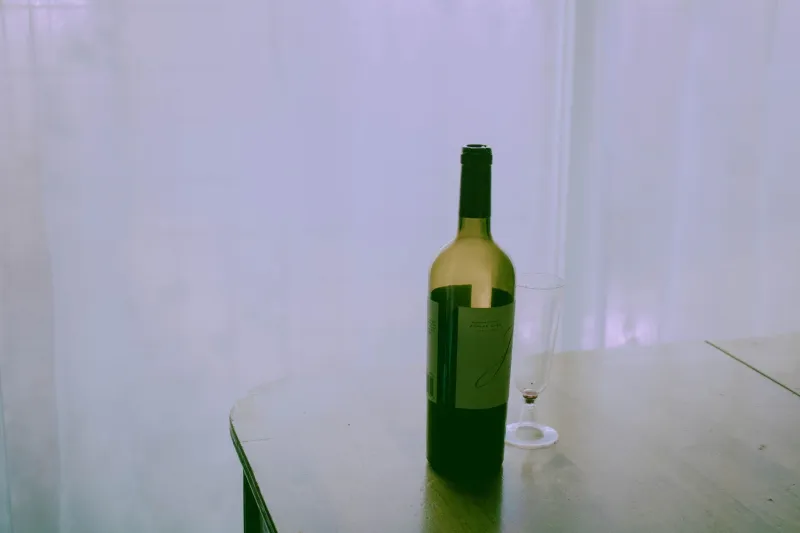
Consider how cinematographers approach the hangover sequence with the same precision a winemaker brings to understanding a wine's finish. The morning after is defined, visually, by light that has lost its warmth. Where the previous evening may have been rendered in amber and candlelight—the chromatic vocabulary of anticipation and pleasure—the dawn that follows is frequently bleached, clinical, or sickly yellow-green. Directors of photography have long understood that color grading is not decoration but argument: when the palette shifts from the saturated richness of a Burgundy to something closer to fluorescent indifference, the audience registers a moral and emotional shift before a single line of dialogue is spoken.
Sound design in hangover sequences operates with equal deliberateness. The clatter of a coffee cup, the distant sound of traffic, a refrigerator's hum—sounds that would be invisible in any other scene become oppressive, intrusive, almost aggressive. This heightened sonic environment is cinema's way of literalizing the hangover's cruelest quality: its insistence on confronting you with a world that has continued, indifferently, while you were elsewhere. The wine promised escape; the morning after denies it.
Focus, too, becomes a storytelling instrument. Shallow depth of field, slightly soft edges, the occasional rack focus that lands just a beat too late—these are the visual correlatives of a consciousness that is not yet fully returned to itself. The camera, in these moments, mimics the experience of a mind reassembling its recent history, searching for the clarity that the previous evening deliberately obscured.
Regret as Narrative Architecture
What separates the most serious hangover films from their more superficial counterparts is the degree to which the morning after functions not as a punchline but as a structural pivot. In films as tonally distinct as Alexander Payne's Sideways and Thomas Vinterberg's Another Round, the aftermath of wine's promises is where character is most nakedly revealed.
In Sideways, the morning sequences carry a particular weight precisely because the film has so carefully established wine as Miles's primary language of self-worth and aspiration. When that language fails—when the gap between the Pinot Noir he rhapsodizes about and the life he has actually constructed becomes impossible to ignore—the morning after is not merely physical discomfort. It is the collapse of an elaborate mythology. Payne shoots these sequences in the unsparing California light that the vineyards themselves look beautiful under, but which offers no mercy to a man confronting his own disappointments.
Vinterberg's Another Round approaches the same territory from a different cultural angle but arrives at an equally demanding conclusion. The Danish film's formal brilliance lies in how it uses the rhythm of intoxication and recovery—repeated, escalated, ultimately catastrophic—to trace the arc of middle-aged men who have confused the loosening of inhibition with the recovery of self. The hangovers in Another Round are progressively less comic and progressively more existential, culminating in a reckoning that the film's celebrated final sequence can only partially redeem.
The Gap Between Anticipation and Reality
What wine culture understands, and what the hangover film dramatizes with particular force, is that the most consequential moment in any relationship with wine is not the opening of the bottle but the morning that follows. The sommelier's blind tasting, the careful decanting, the reverent discussion of terroir and vintage—all of this is, in some sense, the construction of an expectation. The hangover is where that expectation is audited.
Filmmakers who work in this mode are essentially performing the same audit. They are asking, with considerable formal rigor, what remains of a character, a relationship, or an ambition when the intoxicating logic of the night before has fully dissipated. The answer is rarely simple. Sometimes what remains is ruin; sometimes it is something unexpectedly durable; sometimes it is a clarity that the sober hours had actually prevented.
This is, perhaps, why the hangover film tends to attract directors of genuine seriousness. The aesthetic challenges are considerable—shooting a state of diminishment requires as much craft as shooting a state of elevation—but the thematic rewards are proportionally rich. The morning after is, by definition, a moment of radical honesty. The wine has done what wine does; now the character must do what characters do, which is reveal themselves.
Excess, Accountability, and the Cinematic Moral
American cinema has a complicated relationship with excess. The culture's Puritan inheritance tends to insist on consequences, on the morning after as punishment. European filmmaking traditions, by contrast, have often been more ambivalent, more willing to hold the pleasure and the cost in the same frame without resolving them into a lesson.
The most cinematically sophisticated hangover films occupy this ambivalent space. They do not moralize, but they do not flinch. They understand that wine's intoxicating power over narrative—its ability to accelerate intimacy, dissolve inhibition, and create the conditions for both revelation and catastrophe—is precisely what makes it such a resonant metaphor for the storytelling impulse itself. Cinema, like wine, makes promises. The morning after is where both must answer for them.
For the viewer who brings to the screen the same attentiveness that a serious wine professional brings to the glass, the hangover film offers something rare: a formal rigor applied to a fundamentally human vulnerability. The blurred focus will sharpen. The oppressive sound will recede. What remains, in the best of these films, is not merely a character recovering from a night of excess, but a piece of cinema that has used that night—and its aftermath—to say something lasting about the costs of wanting, and the strange, necessary grace of surviving them.