Permanence and Perishability: What Cinema Understands About Immortality That Wine Never Can
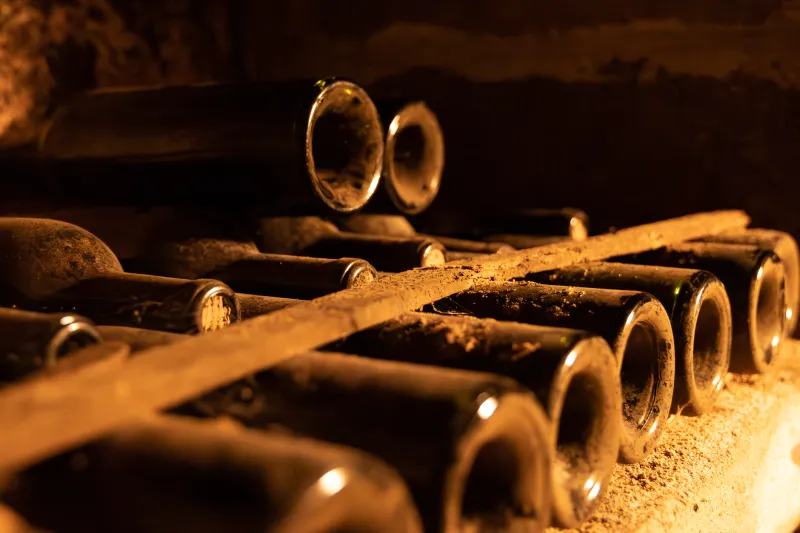
There is a particular kind of melancholy that attaches itself to the final bottle. Collectors who have kept a legendary Pétrus or a storied Burgundy through decades of careful stewardship understand it well — the knowledge that the thing you are about to experience will, in the very act of being experienced, cease to exist. The wine does not survive its own appreciation. It is consumed, and then it is gone, and no amount of reverence or technical mastery can restore what the glass held.
Cinema does not work this way. A film from 1962 — Kubrick's Lolita, Tarkovsky's Ivan's Childhood, Agnès Varda's Cléo from 5 to 7 — can be watched tonight in a condition that approximates, with remarkable fidelity, the experience of its first audience. The reel does not empty. The image does not oxidize. The story does not turn. And this difference, seemingly technical on its surface, opens onto a philosophical divide that says something profound about how human beings create, preserve, and ultimately make meaning from art.
The Cellar's Cruel Arithmetic
Wine exists in a state of perpetual negotiation with time. The finest bottles from celebrated vintages are not simply aging — they are moving along a trajectory that has both a peak and a terminus. Winemakers and collectors speak of drinking windows with the precision of astronomers tracking a comet: the window opens, the wine arrives at its fullest expression, and then, gradually or suddenly, it begins its retreat. The 1961 Latour that inspired reverence at the table in 1985 may, by now, be a shadow of that memory. Or it may be gone entirely, consumed by the very collectors who loved it most.
This is not a flaw in wine. It is, as many in the wine world will argue passionately, its greatest virtue — the irreducible fact of its aliveness. Wine is made from a living thing, it undergoes biological transformation in the bottle, and it participates in the same arc of birth, maturation, and decline that governs all organic matter. To drink a great old wine is to commune with time itself, to taste the specific weather of a specific summer in a specific place, mediated through decades of quiet chemical evolution. The melancholy is inseparable from the meaning.
But the arithmetic remains cruel. The world's greatest wine vintages are finite resources diminishing daily. Every bottle opened is a bottle gone. The 1947 Cheval Blanc exists now only in the memories of those who drank it and in the descriptions they left behind. Future generations will know it only as language — as notes and scores and the hushed reverence of older collectors who speak of it the way people speak of performances they witnessed live and can never fully convey.
What the Film Can and Cannot Lose
Cinema's relationship with time is categorically different, though not without its own vulnerabilities. The history of film preservation is, in part, a history of loss — nitrate prints that burned, early silents that crumbled, studio vaults that flooded. The Library of Congress has estimated that a significant portion of all American silent films have been lost forever, a cultural wound that film historians still mourn. In this respect, cinema and wine share a common tragedy: the irretrievable disappearance of works that no longer exist in any form.
But for the films that survive — and modern preservation efforts have made survival increasingly probable — the experience available to a viewer today is not a diminished version of the original. A 4K restoration of Lawrence of Arabia does not offer less than what audiences encountered in 1962; it may, in certain technical respects, offer more, rendering details of Freddie Young's cinematography with a clarity that the original theatrical projection could not guarantee. The work does not age in the biological sense. It does not peak and decline. It simply persists, available and essentially intact, for any audience willing to seek it out.
This persistence changes the social and cultural life of a film in ways that have no wine equivalent. Vertigo, released in 1958 and withdrawn from circulation for decades by Hitchcock himself, re-emerged in the 1980s and has since accumulated a critical reputation that places it among the greatest films ever made — a reputation built largely by audiences who were not born when it premiered. The wine from 1958 cannot undergo this kind of posthumous reassessment. It can only be remembered, not re-encountered.
Accessibility as a Form of Generosity
There is a democratic dimension to cinema's immortality that wine, by its nature, cannot replicate. The greatest bottles from the greatest vintages have always been the province of the wealthy — not because winemakers intended exclusivity, but because scarcity and demand have made it so. To taste a first-growth Bordeaux from a celebrated year is a privilege that most people will never experience, and that privilege diminishes further with each passing decade as those bottles disappear.
Cinema, at its best, refuses this logic. The films of Bergman and Kurosawa and Cassavetes are available, tonight, to anyone with a library card or a modest streaming subscription. The distance between a serious cinephile in rural Nebraska and one in Manhattan is, in terms of access to the canon, essentially zero. Time does not make great films more exclusive. In many cases, it makes them more accessible — easier to find, better contextualized, more richly discussed.
This is not a trivial observation. It suggests that cinema, as a form, has an embedded egalitarianism that wine — despite all its communal rituals and democratic ambitions — structurally cannot match. The great wine becomes rarer and more expensive with age. The great film becomes more widely available.
What Perishability Teaches
And yet it would be a mistake to conclude that cinema's permanence makes it simply superior to wine as a form of human expression. The very perishability that makes wine heartbreaking is also what makes it urgent. You drink the bottle now, with these people, in this moment, because there is no other option. The experience is unrepeatable by definition. The attention it demands is absolute.
Films, precisely because they can be rewatched, are also perpetually deferred. The viewer always has the option of returning, of catching what was missed, of waiting for a better moment. The wine collector has no such luxury. When the window closes, it closes.
What the asymmetry between these two forms ultimately reveals is not a hierarchy but a spectrum — two different philosophies of what art is for. Wine asks us to be present, to surrender to the moment, to accept loss as the price of beauty. Cinema asks us to return, to accumulate understanding across multiple encounters, to allow meaning to deepen over time without the pressure of finality.
Both are legitimate ways of understanding what it means to make something beautiful and offer it to the world. The fact that one survives and one disappears does not make one more valuable. It makes each, in its own way, irreplaceable.