Neither Empty Nor Full: The Opened Bottle as Cinema's Most Eloquent Symbol of Unresolved Lives
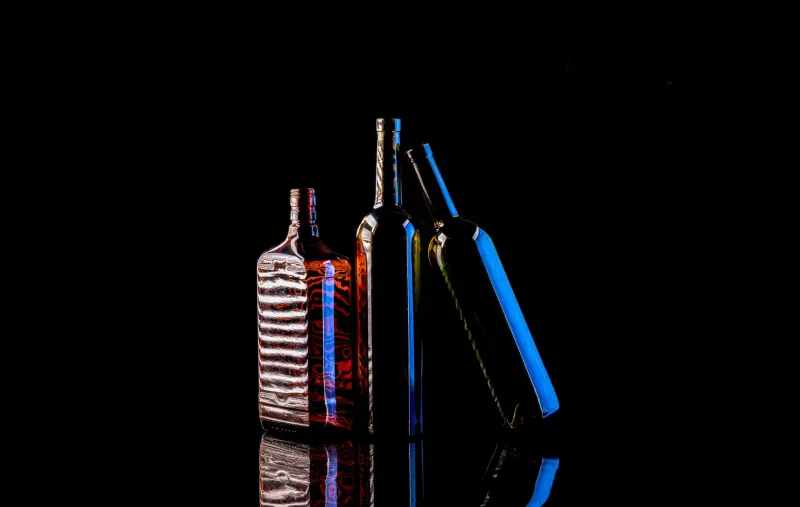
There is a particular kind of stillness that cinema has always understood better than any other art form: the stillness of a thing interrupted. A conversation broken off mid-sentence. A door left neither open nor shut. And, with increasing frequency across the last two decades of serious filmmaking, a wine bottle resting on a table — cork removed, some portion consumed, the remainder catching whatever light the cinematographer has chosen to allow it.
This is not incidental set dressing. Directors who work with any degree of deliberateness know that every object in the frame carries argumentative weight. The opened bottle, in particular, has become one of contemporary cinema's most quietly insistent symbols: an emblem of the transitional, the unresolved, and the irreversibly altered.
The Object Between States
Wine, unlike most consumables, exists in a genuinely liminal condition once the seal is broken. A sommelier will tell you that the moment a bottle is opened, oxidation begins — a slow, inexorable transformation that makes the wine something different from what it was and something other than what it will eventually become. It is neither the pristine, sealed expression of a vintage nor the empty vessel of a completed experience. It occupies an in-between state that has no precise equivalent in ordinary domestic life.
Filmmakers drawn to ambiguity have recognized this quality intuitively. When a character in a drama pours a glass and then abandons the bottle — distracted, called away, simply unable to finish — the residual wine becomes a kind of visual ellipsis. It marks a pause that may or may not resolve. It suggests continuation without promising it.
This is, of course, the condition in which many of the most compelling screen narratives leave their characters. Not destroyed. Not redeemed. Simply altered and ongoing, their trajectories uncertain in ways that feel true to lived experience rather than generic convention.
Ambiguity as Aesthetic Choice
American independent cinema has been particularly fertile ground for this kind of visual thinking. The films that emerged from the Sundance ecosystem in the 2000s and early 2010s — intimate, character-driven works shaped by the influence of European art cinema — frequently employed domestic interiors as psychological landscapes. Wine bottles appeared on kitchen counters and coffee tables with a regularity that was not accidental. They marked evenings that had not gone as planned, conversations that had opened wounds without closing them, relationships hovering at the edge of transformation.
In these contexts, the bottle functions as a kind of narrative timestamp. Its level tells us something about how long a scene has been in progress, how much has been consumed in the attempt to navigate whatever difficulty the characters are facing. But the fact that it is never fully emptied — that the camera often lingers on it as characters part or fall silent — communicates something more essential: that the difficulty itself has not been resolved. The wine, like the problem, remains.
The Tension Between Closure and Continuation
American audiences have a complicated relationship with narrative resolution. The dominant commercial tradition prizes catharsis — the sense that an experience has been completed, that emotional accounts have been settled. Yet there exists a substantial and growing audience, particularly among viewers who seek out festival films and streaming platforms devoted to international and independent work, that has grown skeptical of this expectation. For these viewers, the tidy ending has come to feel not reassuring but dishonest.
The opened bottle speaks directly to this skepticism. It is an object that has been engaged with but not exhausted. Its presence at the end of a scene — or, more pointedly, at the end of a film — communicates that life continues beyond the frame, that the characters we have been watching will carry their unresolved tensions into a future the camera will not follow. This is not failure of narrative nerve. It is, rather, a commitment to a different and more demanding kind of honesty.
Consider how differently a scene reads depending on whether a bottle is full, half-consumed, or empty. A full bottle at the start of a difficult conversation implies resources, possibility, the sense that there is something to draw on. An empty bottle at a scene's conclusion can signify either completion or depletion — the difference between a satisfying meal and a binge. But the half-consumed bottle, resting on the table as the scene ends without resolution, suggests that the characters are still in the middle of something. They have resources remaining. The conversation, or the relationship, or the crisis, is not over.
Wine's Vocabulary of Transition
The wine world has its own language for this transitional state. Winemakers speak of a bottle that has been opened and recorked as something that must be consumed soon — the clock is running, but slowly. The wine is changing, and the direction of that change is not entirely predictable. It may open further, revealing complexities that were masked when it was first poured. It may decline. The outcome is genuinely uncertain in a way that a sealed bottle, with its theoretical perfection, is not.
This vocabulary maps with surprising precision onto the narrative concerns of the films that use opened bottles most deliberately. The characters in these works are also in the process of being changed by exposure — to each other, to circumstance, to the consequences of choices already made. They are no longer who they were at the film's beginning. Whether they will become something richer or simply diminish is left, as in the bottle, genuinely open.
Reading the Frame
For viewers who bring wine literacy to their film watching, the symbolic register of these images is immediately legible. The half-consumed bottle is not background detail but active argument. It is the director saying: this is where we are, and this is what that means — suspended, changed, unfinished.
For viewers who come to these films without that specific cultural context, the image still communicates at a sensory and emotional level. There is something universally understood about the object that has been opened and not completed. It implies interruption. It implies that whatever occasion prompted the opening has not concluded cleanly. It carries, in its very physicality, the weight of the unresolved.
This dual legibility — precise for those who read it symbolically, emotionally available for those who simply feel it — is part of what makes the opened bottle such an effective narrative device. It operates simultaneously as realistic detail and as visual metaphor, satisfying the demands of both naturalistic storytelling and more consciously symbolic filmmaking.
The Honest Incompleteness of Things
Cinema has always been drawn to objects that carry more meaning than their function alone would suggest. The opened bottle earns its place in this tradition not through any particular elegance — it is, after all, a commonplace domestic object — but through the precision with which its physical state corresponds to the emotional and narrative states that serious filmmakers most want to explore.
In a culture still negotiating its relationship with ambiguity, still learning to find satisfaction in stories that do not resolve, the half-consumed bottle offers something quietly radical: a model for incompleteness as a form of integrity. The wine has not been wasted. The occasion has not been abandoned. Something real has happened, and something real remains. That, for the filmmakers who understand it best, is not a failure of resolution. It is the most honest thing that cinema can offer.